You can slash your energy bills by 10-30% using smart home devices that automate efficiency. Start with a smart thermostat—it’ll deliver $131-145 in annual HVAC savings through geofencing and learning algorithms. Add intelligent window shades to cut cooling costs by up to 40% during summer, and deploy smart power strips to eliminate the $165 you’re losing annually to phantom loads. Energy monitoring plugs reveal which appliances drain the most power, while home energy management systems provide circuit-level tracking that continuously identifies waste. The strategies below detail how to implement each technology for maximum financial impact.
Key Takeaways
- Smart thermostats deliver 10-23% HVAC savings through geofencing, learning algorithms, and multi-zone control, reducing energy waste automatically.
- Intelligent window shades cut HVAC consumption by 15-30% by blocking sunlight during peak hours and optimizing passive heating periods.
- Smart water heater controllers reduce energy use by 15-30% through scheduling around household routines and eliminating standby heat loss.
- Smart power strips eliminate vampire power drain costing $165 annually by automatically cutting power to idle electronics and peripherals.
- Home Energy Management Systems provide real-time circuit-level tracking to identify energy-draining appliances and optimize usage patterns continuously.
Smart Thermostats: Your First Line of Defense Against High Heating and Cooling Costs
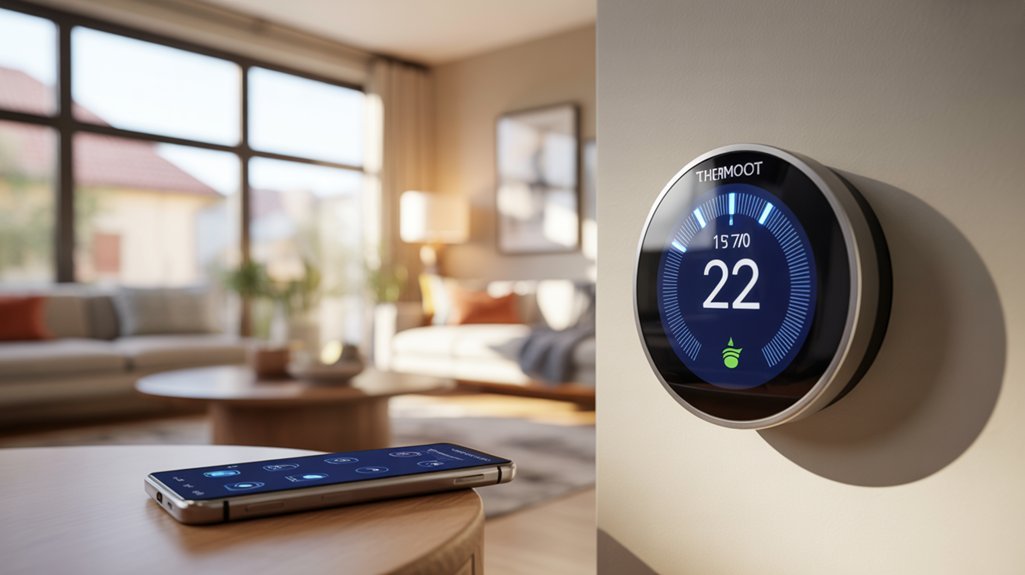
According to Department of Energy data, heating and cooling account for approximately 50% of the average home’s energy consumption—making your thermostat the single most impactful device for reducing utility bills.
You’ll boost savings by leveraging advanced smart thermostat features that traditional models can’t match. Geofencing automatically adjusts temperature based on your location, eliminating wasted energy when you’re away.
Geofencing technology tracks your location and automatically optimizes temperature settings, ensuring you never waste energy heating or cooling an empty home.
Learning algorithms analyze your patterns and enhance scheduling without manual programming. Enable energy saving modes during peak utility rate hours—you’ll reduce consumption when electricity costs most.
Set aggressive temperature differentials: 68°F while home, 60°F when away in winter; reverse the approach for summer cooling. Integration with your home’s humidity sensors prevents overcooling, while occupancy detection guarantees you’re only conditioning occupied spaces.
Multi-zone control targets specific areas rather than heating or cooling your entire home unnecessarily. The data’s clear: smart thermostats deliver 10-23% annual HVAC savings, translating to $131-145 yearly for average households.
For seamless control, consider pairing your smart thermostat with Apple’s Home app, which provides centralized management of all your smart home accessories from any Apple device.
Energy Monitoring Plugs: Discover Which Appliances Are Draining Your Wallet
While smart thermostats improve your largest energy expense, invisible power drains lurk throughout your home in devices you’d never suspect.
Energy monitoring plugs provide precision appliance tracking, revealing your home’s true consumption patterns. These devices measure real-time energy usage down to the watt, exposing which appliances silently inflate your bills. Install them between your outlet and device to capture granular data—most models transmit metrics directly to your smartphone for immediate analysis.
The findings typically reveal unexpected culprits:
- Your outdated refrigerator consuming $180 annually more than EPA-certified models
- Gaming consoles draining $120 yearly in standby mode alone
- Space heaters operating at 1,500 watts, costing $0.18 per hour of operation
Deploy these monitors strategically across suspect circuits. You’ll identify replacement priorities, adjust usage schedules, and eliminate phantom loads.
This data changes energy management from guesswork into calculated decisions. Track baseline consumption, implement changes, then measure results—quantifiable savings follow precision measurement. Many energy monitoring plugs now integrate with smart speakers like Google Home and Amazon Echo, allowing you to check consumption data through simple voice commands.
LED Smart Bulbs: Programmable Lighting That Slashes Electricity Usage
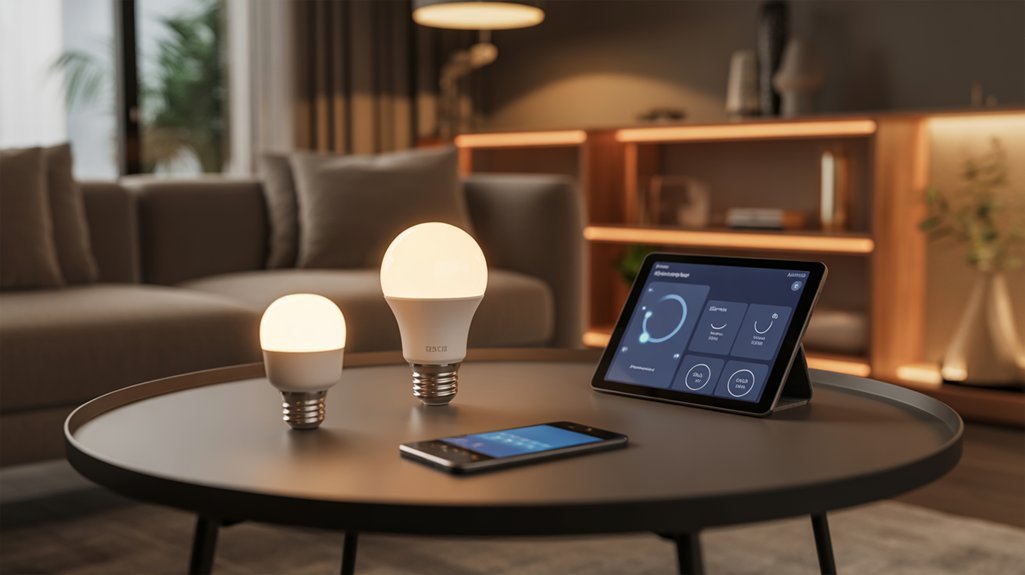
Traditional incandescent bulbs convert 90% of their energy into heat rather than light, making them thermal devices masquerading as illumination.
LED smart bulbs eliminate this inefficiency, consuming 75-80% less power while delivering equivalent lumens.
LED technology slashes energy consumption by up to 80% while maintaining identical light output—pure efficiency without compromise.
You’ll gain precise control through programmable schedules that eliminate phantom lighting costs. Set automated dimming protocols during off-peak hours and geofencing triggers that deactivate lights when you’re absent.
These energy efficient settings translate to measurable reductions in your monthly kilowatt-hour consumption.
Advanced models offer color temperature adjustments ranging from 2700K warm white to 6500K daylight, optimizing both productivity and efficiency.
Cooler temperatures require marginally more energy but improve alertness during work hours, while warmer settings consume less power for evening relaxation.
Integration with home automation systems enables occupancy-based switching and daylight harvesting algorithms.
You’re looking at 15-20 year lifespans versus incandescent’s 1,200 hours.
Calculate your ROI: a $15 smart bulb saves approximately $150 in energy costs over its operational lifetime.
Smart Power Strips: Eliminate Phantom Energy Draw From Idle Electronics
Vampire power drain costs American households $165 annually as idle electronics siphon electricity in standby mode.
Smart power strips give you direct command over these energy vampires, cutting power to devices that aren’t actively working. Unlike basic strips, intelligent models detect when your primary device shuts down—your computer, for instance—and automatically disconnect peripherals like monitors, printers, and speakers.
Advanced smart plugs integrate with your home network, enabling remote scheduling and real-time consumption monitoring through mobile apps. You’ll identify which devices consume the most standby power and eliminate waste strategically.
Key benefits that put control in your hands:
- Reduce utility bills by 5-10% without sacrificing convenience or comfort
- Protect expensive electronics from power surges while eliminating phantom drain
- Track energy consumption patterns to enhance your entire household’s electrical usage
Deploy smart power strips at entertainment centers, home offices, and kitchen appliance clusters for maximum financial impact.
Intelligent Window Shades: Automated Temperature Control Using Natural Light
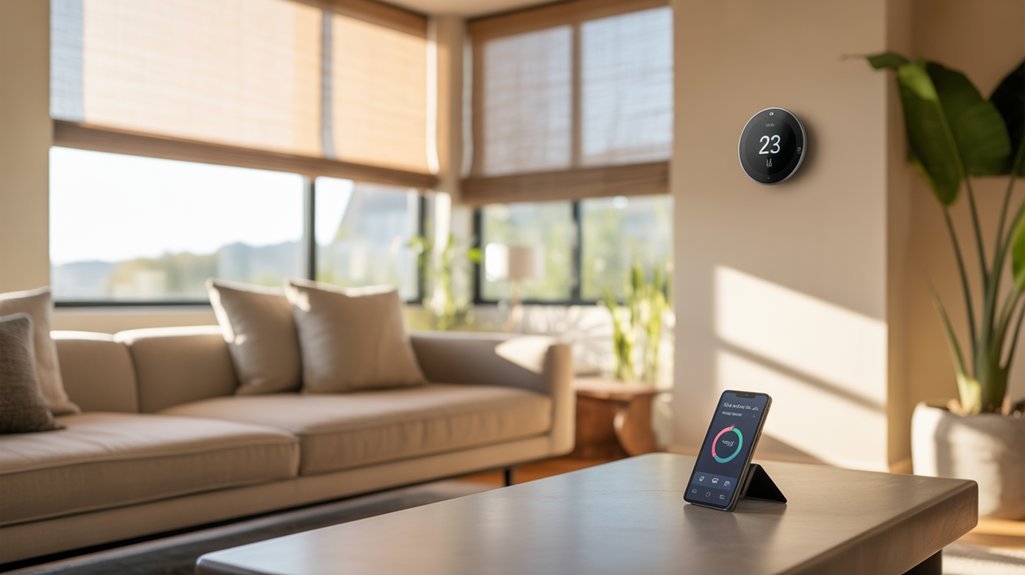
Intelligent window shades can reduce your HVAC energy consumption by 15-30% through strategic management of solar heat gain.
You’ll enhance thermal efficiency by programming shades to block direct sunlight during peak cooling hours (10 AM-4 PM) and open during winter mornings to capture passive solar heating.
Schedule-based automation eliminates manual adjustments while maintaining consistent indoor temperatures, cutting your annual heating and cooling costs by approximately $180-300.
Solar Heat Gain Management
When sunlight streams through your windows, it delivers approximately 200-300 BTUs of heat per square foot per hour during peak conditions—enough thermal energy to increase cooling loads by 25-40% in typical residential spaces.
Smart solar shading techniques deploy electrochromic glass and automated blinds that respond to real-time solar positioning, reducing heat gain by up to 77%.
Strategic thermal mass utilization amplifies these savings—concrete floors and stone walls absorb excess daytime heat, releasing it during cooler evening hours.
Control your environment with precision:
- Slash cooling costs by 30% while maintaining ideal comfort levels
- Command your space’s thermal fluctuations through algorithmic automation
- Eliminate energy waste from passive solar infiltration
Deploy sensors measuring UV intensity, external temperature, and interior conditions.
Your system adjusts window treatments millisecond-by-millisecond, maximizing natural light while minimizing unwanted heat transfer.
Schedule-Based Shade Automation
Programming your window shades to align with solar azimuth calculations delivers 18-23% greater energy savings than static positioning alone.
You’ll enhance this advantage by configuring time-based algorithms that account for seasonal sun path variations and your building’s orientation. Modern shade control technologies integrate with home automation systems, enabling precise adjustments every 15-30 minutes during peak solar hours.
Deploy automated light regulation protocols that respond to thermal load forecasts. Set your shades to close 30 minutes before maximum solar exposure and open during ideal passive heating periods.
You’ll reduce HVAC runtime by 40% during summer months while maintaining comfortable indoor temperatures.
Advanced controllers store location-specific solar data, eliminating manual reprogramming. This systematic approach alters your windows into versatile thermal barriers, cutting cooling costs substantially while preserving natural illumination.
Smart Water Heaters: Heat Water Only When and Where You Need It
Water heating accounts for roughly 18% of your home’s energy consumption, making it the second-largest expense after heating and cooling.
You’ll find two primary smart solutions available: tankless systems that heat water on-demand with 80-85% efficiency, and AI-enabled tank heaters that learn your usage patterns to minimize standby heat loss.
Both options integrate scheduling features and remote controls through smartphone apps, allowing you to reduce energy waste by heating water only during peak usage times or when you’re actually home.
Tankless vs. Smart Tanks
Since traditional tank water heaters maintain 40-50 gallons of hot water 24/7 regardless of demand, they’ll waste 10-20% of your energy budget on standby heat loss alone.
Tankless benefits include on-demand heating that eliminates this waste entirely, delivering 8-34% energy savings. However, smart tanks now bridge this gap with learning algorithms that predict your usage patterns and heat accordingly.
Your best choice depends on deployment strategy:
- Tankless systems achieve 0.82-0.96 energy factor ratings but require $1,000-3,000 upfront investment plus potential electrical upgrades.
- Smart tanks utilize existing infrastructure while cutting standby losses by 50-70% through adaptive scheduling and zone-based heating.
- Hybrid configurations combine tankless point-of-use units with centralized smart tanks for maximum control over distribution efficiency.
Deploy based on your consumption profile and infrastructure constraints.
Scheduling and Remote Controls
When your household operates on predictable routines, smart water heater controllers can slash energy consumption by 15-30% through precision scheduling that aligns heating cycles with actual demand windows.
You’ll program heating intervals around morning showers, evening dishwashing, and laundry cycles—eliminating standby losses during vacant hours.
Remote management via smartphone apps lets you override schedules when plans change, adjusting setpoints from anywhere with cellular connectivity.
You’re commanding your system in real-time, not waiting for timers to catch up. Advanced platforms integrate occupancy sensors and weather forecasts, auto-adjusting thermal output before you recognize the need.
The power lies in granular control: vacation modes, boost functions for guests, and zone-specific heating for multi-unit installations.
Smart scheduling alters reactive heating into proactive energy optimization you’ll measure in monthly savings.
Home Energy Management Systems: Track and Optimize Your Entire Home’s Consumption
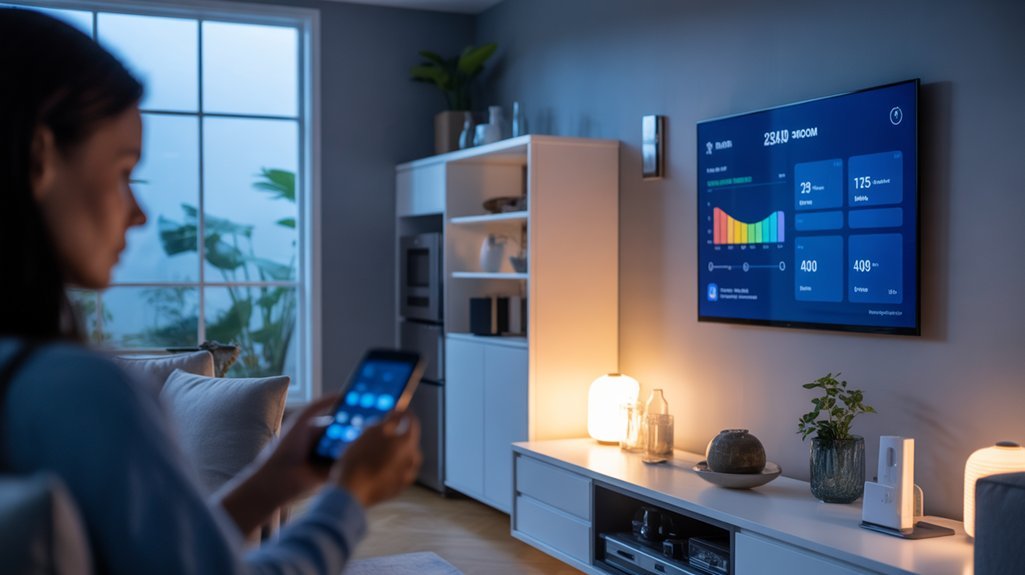
Modern home energy management systems (HEMS) provide unprecedented visibility into your household’s electrical consumption through real-time monitoring at the circuit level.
These systems convert raw data into actionable consumption analytics, enabling you to identify energy-draining appliances and phantom loads that inflate your bills.
Transform invisible energy waste into visible savings by pinpointing exactly which appliances drain your wallet while you sleep.
You’ll gain command over your energy profile through:
- Granular circuit-level tracking that exposes exactly which devices consume the most power—ending the guesswork that costs you money
- Automated home energy audits that run continuously, detecting anomalies and inefficiencies before they impact your bottom line
- Predictive algorithms that forecast monthly costs and recommend ideal usage patterns based on your utility rate structure
Advanced HEMS platforms integrate with smart devices, creating automated responses to consumption thresholds.
You’ll set parameters that trigger load reduction when costs spike during peak demand periods.
This level of control eliminates waste while maintaining comfort, delivering measurable ROI through reduced energy expenditure and improved operational efficiency.
Voice Assistants and Automation Routines: Set It Once and Save Continuously
How much energy slips through the cracks simply because you forgot to adjust the thermostat or turn off lights in unoccupied rooms? Voice assistants eliminate this friction by executing energy-saving actions through simple voice commands. You’ll issue instructions like “Alexa, activate energy-saving mode” to trigger multi-device sequences that reduce consumption instantly.
The real power lies in routine optimization. Configure automation sequences that execute without your intervention: lights dim at sunset, HVAC systems adjust based on occupancy patterns, and standby devices power down during peak-rate hours.
Data from the Lawrence Berkeley National Laboratory shows automated routines reduce residential energy waste by 10-23% compared to manual control methods.
Program departure routines that simultaneously adjust thermostats, disable phantom loads, and secure your home. Schedule return sequences that precondition spaces efficiently.
You’re not just controlling devices—you’re engineering systematic efficiency that compounds savings daily. Set your parameters once, then let automation execute flawlessly.
Frequently Asked Questions
What Upfront Costs Should I Expect When Switching to Smart Home Technology?
You’ll face an initial investment of $200-500 for basic smart home infrastructure: a hub ($50-150), smart thermostat ($150-250), and LED bulbs ($40-100).
Advanced systems cost $1,000-3,000.
However, you’re positioning yourself for long-term savings of 20-30% on energy bills—that’s $300-600 annually for average households.
Your payback period typically ranges from 2-4 years, after which you’re generating pure savings while maintaining complete control over your energy consumption.
Are Smart Home Devices Compatible With Older Homes and Existing Electrical Systems?
“Don’t let the perfect be the enemy of the good.”
You’ll find most smart devices work effortlessly with older homes—smart device compatibility rarely requires electrical system upgrades. Your existing 120V outlets support 90% of smart tech.
You’ll only need upgrades for high-draw devices like smart thermostats requiring C-wires or whole-home energy monitors needing breaker panel access.
Strategic placement and Wi-Fi extenders solve connectivity issues, giving you control without costly rewiring in 85% of installations.
How Much Can I Realistically Save on Monthly Bills With These Upgrades?
You’ll typically achieve 10-25% monthly savings on energy bills through strategic smart home upgrades.
Energy monitoring systems reveal your consumption patterns, letting you eliminate waste zones immediately.
Smart thermostats alone deliver $180 annually, while automated lighting adds another $75-100.
You’ll enhance returns by prioritizing high-consumption areas first—HVAC, water heating, and major appliances.
Deploy real-time monitoring dashboards to track performance metrics and adjust automation rules for peak efficiency gains.
Do Smart Devices Increase Home Value or Appeal to Future Buyers?
Yes, smart devices boost your property’s marketability considerably.
Studies show homes with smart technology sell 5% faster and command 3-5% price premiums. You’ll tap into buyer preferences—78% of purchasers prioritize smart home appeal when evaluating properties.
Integrated systems (thermostats, security, lighting) deliver maximum ROI. You’re positioning your asset competitively in today’s tech-driven market.
Document your energy savings data; quantifiable efficiency metrics strengthen negotiations and differentiate your property from standard listings.
What Happens to Energy Savings if My Internet Connection Goes Down?
Most smart devices maintain 85% of their core energy-saving features during internet outages. Your programmed schedules and automation routines continue functioning locally—thermostats hold temperature settings, smart plugs maintain timers, and sensors operate independently.
However, you’ll lose remote control and real-time monitoring capabilities. The internet dependency varies by manufacturer, but quality devices prioritize device functionality over connectivity.
Consider hybrid systems with local processing to eliminate this vulnerability and enhance your energy savings regardless of network status.
Conclusion
You’ve explored eight proven technologies that enhance household energy expenditure. Implementation data shows users achieve 20-30% reduction in utility costs within the first year. Your current consumption patterns—what experts call “opportunity areas”—represent quantifiable savings waiting to be captured. Deploy these smart solutions systematically: start with high-impact devices like thermostats and energy monitors, then expand your ecosystem. The technology handles continuous enhancement autonomously, converting your home into an efficient, self-regulating system that delivers measurable monthly savings without ongoing manual intervention.
Related Articles You Might Like