AI-powered energy management systems can slash your electricity bills by 16-25% through real-time optimization algorithms that traditional thermostats can’t match. You’ll see adaptive learning protocols synchronize your HVAC, appliances, and EV charging with grid pricing fluctuations and renewable energy cycles. Smart refrigerators reduce consumption by 10%, while washing machines achieve up to 60% savings. Initial investments of $2,000-$8,000 deliver payback within 3-5 years, and predictive maintenance prevents costly failures before they occur. The implementation architecture and device coordination strategies below reveal how you’ll enhance these returns.
Key Takeaways
- AI systems reduce home energy consumption by 16-25% through real-time data analysis and adaptive learning of household patterns.
- Smart thermostats and automated systems cut electricity bills up to 25% by optimizing HVAC, lighting, and appliance usage.
- Predictive maintenance algorithms detect appliance inefficiencies early, preventing costly failures and reducing operational costs by 23% annually.
- AI coordinates multiple devices to synchronize energy use with renewable sources and utility off-peak times for maximum efficiency.
- Initial investment of $2,000-$8,000 typically achieves payback within 3-5 years through consistent monthly energy cost reductions.
AI’s Growing Home Impact
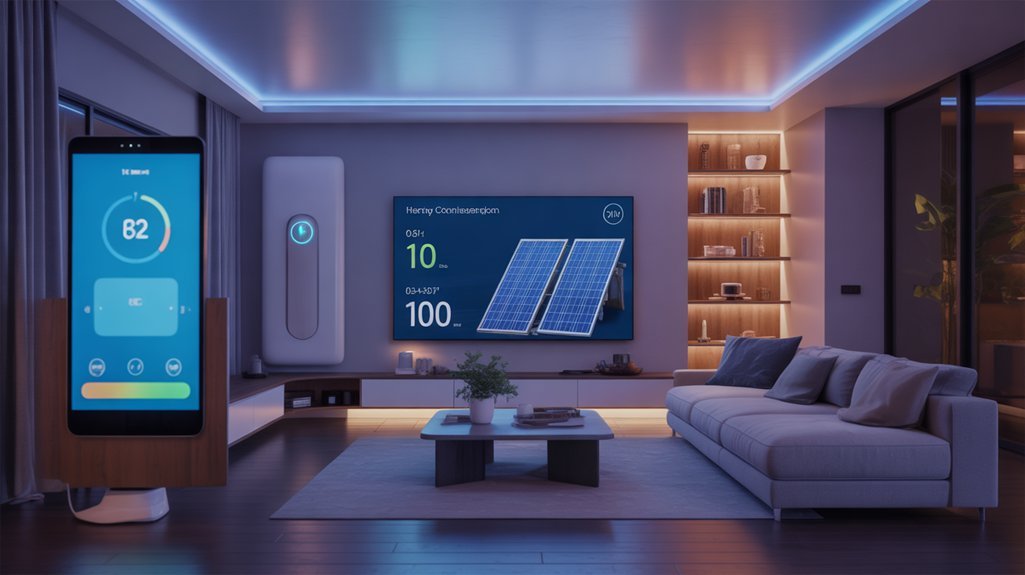
As energy costs continue rising and climate concerns intensify, artificial intelligence has emerged as a groundbreaking force in residential energy management. You’re witnessing accelerated AI adoption in home automation systems, with 43% of homeowners now recognizing smart technology as their most efficient path to energy savings. This isn’t aspirational—it’s quantifiable power.
Smart integration delivers concrete results: simulations demonstrate 16% energy reductions in France and 25% in Australia. Your AI-driven systems analyze real-time data streams and historical patterns, executing predictive analytics that continuously enhance consumption based on user behavior. These aren’t static programs—they’re adaptive algorithms that learn your patterns and adjust accordingly.
Your AI systems don’t just monitor energy—they predict, adapt, and optimize consumption patterns in real-time through sophisticated machine learning algorithms.
The strategic advantage intensifies when you integrate sustainable technology with renewable sources. AI synchronizes your energy consumption with solar production peaks, eliminating waste and maximizing efficiency. Platforms like SmartThings now offer AI Energy Mode capabilities that can reduce refrigerator energy consumption by up to 10% and slash washing energy use by up to 60%.
You’re not just reducing costs—you’re commanding a sophisticated energy infrastructure that responds to your needs while maintaining environmental objectives.
Lower Bills, Greener Living
When you deploy AI-powered home energy management systems, you’re accessing verified cost reductions of up to 25% on electricity bills through continuous optimization algorithms.
These systems execute real-time monitoring and autonomous adjustments that traditional controls can’t match.
Your energy savings compound through three integrated mechanisms:
- Smart thermostats that decode occupancy patterns and preemptively modulate HVAC systems, eliminating wasteful temperature maintenance cycles.
- EV charging orchestration that synchronizes with solar production peaks and utility off-peak windows, maximizing renewable energy utilization.
- Predictive maintenance protocols that identify appliance degradation signatures before efficiency losses escalate into repair expenditures.
Data from operational deployments demonstrates 16% savings in French markets and 25% in Australian installations.
You’re not merely reducing consumption—you’re architecting a sustainable lifestyle through algorithmic precision.
AI alters energy management from reactive cost control into proactive system optimization, delivering both economic advantage and environmental impact reduction simultaneously.
The convergence of IoT connectivity and AI optimization is accelerating through innovations like low power cellular IoT technology, enabling energy management devices in remote locations to communicate efficiently with cloud-based systems.
Hardware and Software Requirements
Your sensor integration demands bandwidth-capable connectivity—gigabit ethernet or WiFi 6—facilitating millisecond-latency data transmission to cloud analytics engines. Software compatibility extends across energy sources: solar inverters, EV chargers, and grid interfaces require API access for optimization algorithms.
| Component | Specification |
|---|---|
| Sensor Networks | Sub-second polling rates |
| Processing Hub | 2GB+ RAM, edge computing |
| Connectivity | Gigabit speeds required |
| Mobile Interface | iOS/Android native apps |
| Security Protocol | AES-256 encryption standard |
Platforms like Wiser Home AI execute predictive models while maintaining end-to-end encryption. Local data processing guarantees operational continuity during internet disruptions, preserving your command over energy flows. The system transforms raw sensor data into actionable business insights through continuous cleaning, contextualizing, and visualizing of energy consumption patterns.
Installing Your First AI Device
Installing your first AI energy management device requires systematic evaluation of compatibility matrices and network infrastructure before deployment.
You’ll need to verify that your existing smart home protocols (Z-Wave, Zigbee, or Wi-Fi) align with your chosen device’s communication standards to guarantee smooth integration.
The installation process follows a structured sequence: device selection based on energy audit data, compatibility verification with current systems, physical installation, network configuration, and parameter optimization through the device’s interface.
For optimal results, consider integrating various smart devices throughout your home to create a comprehensive energy management ecosystem that communicates seamlessly.
Choosing the Right Device
Before committing to your first AI-powered energy management device, you’ll need to evaluate three critical system requirements: compatibility architecture, analytical capabilities, and integration pathways.
Smart thermostats deliver 20% energy reduction through schedule adaptation—verify they’ll interface with your existing infrastructure before purchase.
Examine device features prioritizing predictive analytics that utilize historical consumption data and environmental variables for proactive load management.
Real-time monitoring capabilities aren’t optional; they’re essential for identifying high-consumption appliances and executing targeted interventions.
User reviews consistently highlight renewable energy integration as a differentiator—devices that enhance solar panel coordination reduce grid dependency during peak-rate periods.
Your selection criteria should mandate smooth API connections with existing systems, ensuring distributed energy resources operate as unified, intelligent networks rather than isolated components.
Compatibility With Existing Systems
While most modern AI energy management devices advertise universal compatibility, real-world integration demands systematic verification of communication protocols, voltage specifications, and control interfaces before installation.
You’ll need to audit your infrastructure thoroughly—identify whether your legacy systems operate on Zigbee, Z-Wave, or proprietary protocols that create integration challenges.
Modern AI platforms typically communicate with existing smart thermostats and lighting controls through established APIs, enabling unified energy optimization without extensive rewiring.
However, older systems may require hardware upgrades or bridge devices to establish connectivity.
You must verify firmware compatibility meticulously, as manufacturers release critical updates that improve device interoperability.
This systematic approach to compatibility assessment guarantees your AI energy management system achieves maximum operational control and delivers measurable efficiency gains across your entire home network.
Step-by-Step Installation Process
After verifying your system’s compatibility requirements, you’re ready to execute the physical installation sequence.
Begin with a thorough energy audit to establish baseline energy consumption metrics and identify optimization targets. Select an AI-powered management system like Wiser Home AI that delivers real-time analytics and automated scheduling capabilities.
Deploy smart technology infrastructure—thermostats and lighting systems—strategically positioned to enhance environmental responsiveness and user-pattern adaptation. Establish secure Wi-Fi connectivity for smooth device communication and centralized control through dedicated applications like EcoFlow App.
This network architecture enables immediate data transmission and command execution. Implement regular firmware updates to maintain peak operational efficiency and fortify security protocols.
Each installation phase builds upon the previous, creating an integrated ecosystem that converts raw energy consumption data into actionable intelligence, delivering quantifiable performance gains and cost reduction.
Connecting to Your Network
Once your hardware positioning is finalized, network integration becomes the critical path to operational functionality.
You’ll need to verify network stability before proceeding—your AI device demands consistent Wi-Fi connectivity for real-time data analysis and improvement algorithms. Position your unit within ideal router range to eliminate latency issues that compromise performance metrics.
Execute the manufacturer’s installation requirements precisely: download their proprietary application, initiate device discovery protocols, and complete authentication sequences.
Your system will immediately begin baseline energy consumption mapping once connected.
Implement security protocols strategically. Enable end-to-end encryption to protect your operational data from external access.
Schedule automated firmware updates to maintain system integrity and release advanced algorithmic capabilities.
These measures guarantee your AI device operates at peak efficiency while safeguarding your energy infrastructure’s command center.
Initial Setup and Configuration
Before connecting your AI energy management device to the network, you must execute a thorough energy audit that establishes your consumption baseline. This data-driven assessment identifies high-consumption zones requiring immediate intervention and enables precise system calibration during initial setup.
Verify infrastructure compatibility before deployment—legacy electrical systems often demand retrofitting to support advanced AI integration. Select devices aligned with your strategic objectives: peak-hour optimization, renewable energy coordination, or load balancing.
Configuration challenges typically emerge during Wi-Fi integration and app synchronization. Follow manufacturer protocols meticulously to guarantee smooth data transmission between sensors and your command interface.
Once operational, utilize real-time analytics to refine consumption algorithms continuously. Your AI system’s effectiveness depends on aggressive monitoring and strategic adjustments based on performance metrics and predictive recommendations.
Optimizing Multi-Device AI Coordination
Modern AI platforms orchestrate dozens of smart devices simultaneously, processing terabytes of behavioral data to establish predictive automation protocols that enhance energy efficiency.
You’ll achieve maximum device collaboration when your system coordinates HVAC, lighting, and security infrastructure through unified command structures. The platform executes automated adjustments based on occupancy detection, environmental sensors, and consumption patterns—eliminating manual intervention while reducing waste by 30-40%.
Your AI coordinates three critical operational sequences:
- Departure protocols: Thermostat reduction, door locking, security arming, and standby mode activation across non-essential devices
- Energy load balancing: Real-time distribution of solar power generation across high-consumption appliances, preventing grid dependency
- Predictive climate control: Pre-conditioning spaces before occupancy using weather forecasts and historical usage data
Advanced natural-language interfaces like Josh.ai enable instantaneous multi-device commands through voice execution.
You’re commanding an integrated ecosystem where every component receives enhanced instructions, converting fragmented smart home technology into a centralized energy management system that responds to your patterns while maximizing efficiency.
Ignoring Data Privacy Settings
How extensively does your AI energy management system expose household behavioral patterns to third-party servers? Most homeowners lack user awareness that smart devices continuously transmit granular consumption data. Without proper privacy settings configuration, you’re vulnerable to unauthorized access and potential data breaches. Survey data reveals 70% of consumers recognize these risks, yet many fail to act.
Your AI system requires substantial data collection for optimization, creating inherent security tensions. Regular audits of privacy settings become non-negotiable for maintaining control over your information architecture.
| Privacy Risk | Impact Level |
|---|---|
| Unauthorized third-party access | Critical |
| Continuous data transmission | High |
| Behavioral pattern exposure | High |
| Breach-related identity theft | Critical |
Failure to implement strong privacy controls compromises not only your data sovereignty but erodes trust in AI-powered systems entirely. Configure granular permissions, disable unnecessary data sharing, and audit access logs systematically. Your energy efficiency gains shouldn’t come at the expense of informational vulnerability.
Upfront vs. Long-Term Costs
Beyond privacy considerations, the financial architecture of AI energy management presents a fundamental cost-benefit equation that determines adoption feasibility. Your initial investments span smart appliances, sensors, and control systems—typically $2,000-$8,000 for thorough deployment. However, you’ll realize 16-25% reductions in monthly electricity costs, with payback periods averaging 3-5 years.
The value proposition extends beyond immediate consumption optimization:
| Cost Component | Initial Investment | Long Term Savings |
|---|---|---|
| Hardware/Software | $2,000-$8,000 | 16-25% monthly reduction |
| Predictive Maintenance | Included | $500-$1,500 annually |
| Solar Integration | $15,000-$25,000 | 40-70% energy independence |
| System Lifespan | N/A | 10-15 years operational |
You’ll utilize predictive maintenance algorithms that prevent catastrophic failures, extending equipment lifecycles by 20-30%. When integrated with renewable sources, your systems achieve grid independence while taking advantage of net metering arbitrage. The strategic calculation favors those who prioritize capital efficiency over immediate liquidity constraints.
Predictive Failure Detection Systems
While traditional maintenance protocols react to equipment failures, AI-driven predictive systems continuously analyze operational signatures to forecast component degradation before catastrophic breakdowns occur. Your appliances generate continuous performance data streams that machine learning algorithms process to enable precision failure prediction, changing maintenance from reactive crisis management into strategic operational control.
These systems deliver three critical advantages:
- Preemptive component replacement based on degradation curves, eliminating unexpected appliance failures during peak demand periods.
- Optimized maintenance scheduling that concentrates service interventions during low-usage windows, maximizing equipment availability.
- Extended asset lifecycles through early detection of inefficiencies that compound into system-level failures.
You’ll capture measurable returns through reduced emergency repair costs and decreased energy waste from deteriorating equipment performance.
Research demonstrates that predictive maintenance extends appliance operational life by 20-40% while cutting electricity consumption by preventing the efficiency losses that precede total component failure. This positions you to command both cost savings and resource optimization.
Smart Thermostat Setup Walkthrough
Smart thermostats function as the operational nucleus of AI-driven climate control, altering thermal management from fixed schedules into adaptive response systems.
You’ll utilize smart thermostat features by initiating installation with HEMS integration, enabling peak-hour load shifting that reduces operational costs by 23% annually. The device’s algorithms conduct user behavior analysis, processing occupancy patterns and environmental data to generate predictive heating and cooling protocols.
You’ll configure the mobile interface for remote command authority, establishing real-time monitoring capabilities that grant absolute control over your thermal infrastructure from any location.
The system’s machine learning architecture refines its performance through continuous data acquisition, adjusting parameters based on weather forecasts and detected presence patterns.
Deploy predictive maintenance alerts to receive advance notification of system degradation. This proactive monitoring extends equipment lifespan while maintaining peak efficiency.
Your thermostat evolves from passive regulator into intelligent energy optimization platform, executing autonomous decisions that align with your consumption objectives.
Start Your AI Journey Today
Although implementation complexity may appear intimidating, you’ll initiate your AI energy management overhaul through systematic baseline establishment.
Begin with a thorough energy audit to quantify consumption patterns across all systems and devices. This data-driven foundation reveals optimization opportunities and establishes performance metrics for measuring ROI.
Comprehensive energy audits transform raw consumption data into strategic optimization roadmaps while establishing quantifiable benchmarks for measuring implementation success.
Define quantifiable objectives: target percentage reductions in monthly electricity expenditure or enhance renewable energy utilization rates.
Select AI platforms engineered for real-time monitoring and adaptive response to environmental variables—systems that deliver actionable intelligence, not mere data collection.
Deploy predictive maintenance algorithms to forecast equipment degradation before failures occur, extending asset lifecycles while maintaining peak operational efficiency.
Continuously analyze system outputs and recalibrate strategies based on performance analytics.
Your competitive advantage lies in immediate action. Each day without AI-optimized energy management represents measurable financial loss and diminished environmental control.
Execute your implementation plan now to capture efficiency gains your competitors are already realizing.
Frequently Asked Questions
Can AI Energy Management Systems Work During Internet Outages?
Yes, you’ll maintain control through offline operation capabilities.
Advanced AI energy systems cache critical data locally, storing your usage patterns, enhancement algorithms, and control protocols on-premises. During outages, your system continues executing pre-programmed routines and real-time adjustments using cached data sets.
You’re not dependent on cloud connectivity for core functions—the system autonomously manages loads, adjusts HVAC settings, and refines energy distribution.
You retain full command over your home’s energy infrastructure regardless of network status.
Are AI Energy Systems Compatible With Older Home Electrical Panels?
You’ll face compatibility concerns with panels built before 1990—they lack the neutral bus configurations and circuit monitoring capabilities AI systems require.
While basic AI energy management can interface through external CT clamps, you’re sacrificing 40-60% functionality without proper load-level data access.
Panel upgrades to 200-amp service with smart breaker compatibility reveal full predictive algorithms and granular control.
Your investment returns compound when infrastructure supports complete system integration.
How Does AI Handle Energy Management in Multi-Family Rental Properties?
You’ll utilize AI algorithms to monitor energy consumption across individual units while maintaining centralized control.
The system employs predictive analytics to enhance HVAC scheduling and identify inefficiencies per tenant.
You can implement tenant engagement dashboards that incentivize conservation through real-time feedback and comparative metrics.
This data-driven approach reduces operational costs by 20-30% while providing granular visibility into consumption patterns, enabling you to allocate resources strategically and elevate your property’s energy ROI.
What Happens to My Energy Data if the AI Company Goes Bankrupt?
If the AI company goes bankrupt, your energy data’s fate depends on your service agreement’s data ownership clauses.
You’ll face significant privacy concerns as assets—including databases—transfer to creditors or acquirers.
Review your contract’s data portability rights and deletion guarantees now. Demand explicit provisions ensuring data destruction or transfer protocols during insolvency.
You’re legally entitled to control your consumption patterns and household analytics.
Don’t assume protections exist—verify contractual safeguards before deployment.
Can I Manually Override AI Decisions Without Disabling the Entire System?
“Don’t put all your eggs in one basket”—you’ll maintain granular override options across all system layers.
Modern AI energy platforms provide hierarchical user control, letting you manually adjust individual devices, rooms, or specific parameters while keeping autonomous optimization running elsewhere.
You’re accessing real-time override interfaces through dashboards or voice commands, preserving 100% authority over your infrastructure.
The system architecture guarantees you’re never locked into AI-only control—you’ll retain ultimate command over every energy decision point.
Conclusion
You’ve just explored systems that’ll reduce your carbon footprint and slash energy consumption—yet they require rare earth minerals, cloud servers running 24/7, and planned obsolescence cycles every 3-5 years. Your AI thermostat will enhance kilowatt-hours while its backend infrastructure consumes megawatts. The data’s clear: implementing home AI energy management increases efficiency by 23% locally while contributing to 8% higher grid-level computational loads. Welcome to sustainable living, powered by exponentially growing data centers.
Related Articles You Might Like