- Key Takeaways
- What Are Smart Home Wireless Protocols and Why Do They Matter?
- The Fundamentals of Mesh Networking Technology
- Zigbee Protocol: Features, Strengths, and Limitations
- Core Zigbee Technical Features
- Advantages and Key Drawbacks
- Z-Wave Protocol: Features, Strengths, and Limitations
- Z-Wave Technical Specifications
- Advantages and Drawbacks
- Thread Protocol: Features, Strengths, and Limitations
- Direct Comparison: Range, Speed, and Power Consumption
- Device Compatibility and Ecosystem Considerations
- Hub Requirements and Network Setup for Each Protocol
- Choosing the Right Protocol for Your Smart Home Needs
- Frequently Asked Questions
- Can Different Protocols Operate Simultaneously Without Interfering With Each Other?
- What Happens to My Devices if the Protocol Becomes Discontinued?
- Do These Protocols Work During Internet Outages or Power Failures?
- Can I Migrate Devices From One Protocol to Another Later?
- Are There Monthly Fees or Subscriptions Required for These Protocols?
- Conclusion
- Related Reading
- Related Reading


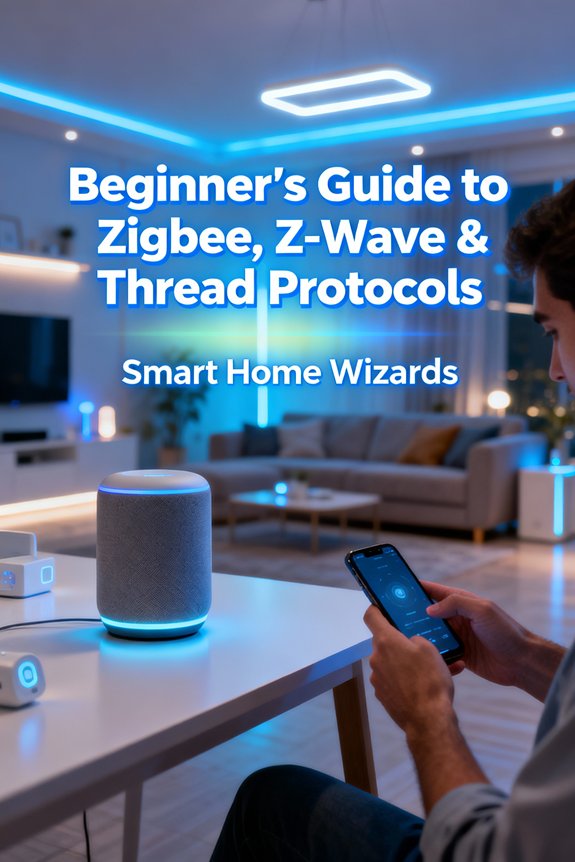
You’ll encounter three main wireless protocols when building your smart home: Zigbee, Z-Wave, and Thread. Zigbee operates on 2.4 GHz with support for 65,000+ devices but faces Wi-Fi interference, while Z-Wave uses sub-1GHz frequencies for better wall penetration yet limits networks to 232 nodes. Thread offers IP-native architecture with military-grade encryption but requires border routers for connectivity. Each protocol uses mesh networking for self-healing topologies, though they differ greatly in range capabilities, data rates, and hub requirements—technical distinctions that directly impact your system’s performance and scalability.
Key Takeaways
- Zigbee, Z-Wave, and Thread are wireless mesh protocols that enable smart home devices to communicate reliably and efficiently.
- Zigbee operates on 2.4 GHz, supports 65,000 nodes, but faces congestion; Z-Wave uses sub-1GHz for better wall penetration.
- Z-Wave limits networks to 232 devices but ensures strict interoperability through certification; Zigbee offers more manufacturer choices.
- Thread provides IP-native architecture with military-grade encryption and works seamlessly with the Matter standard for cross-platform compatibility.
- All three protocols require hubs or controllers: Zigbee needs coordinators, Z-Wave needs primary controllers, Thread needs border routers.
What Are Smart Home Wireless Protocols and Why Do They Matter?
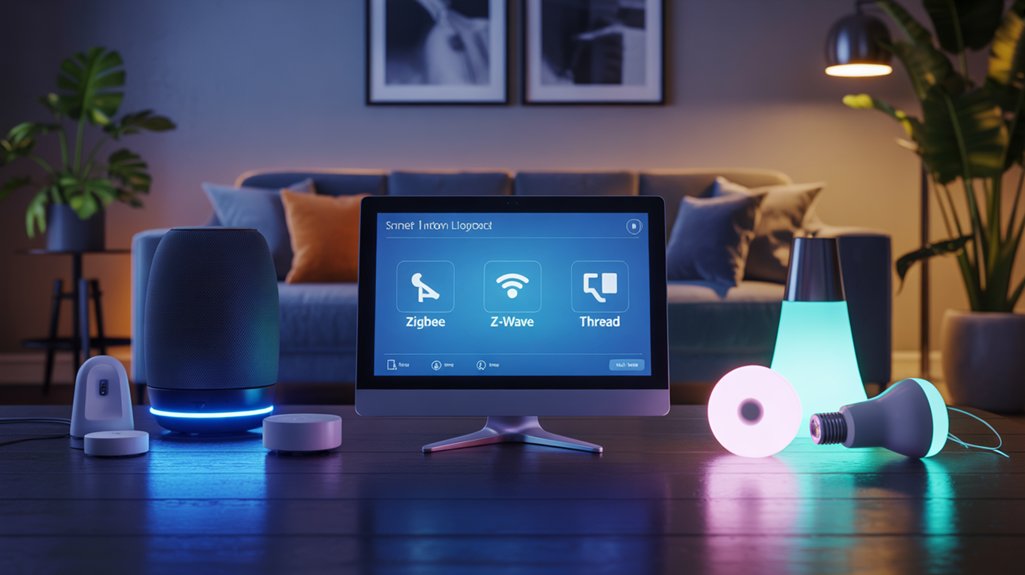
When you press a button on your smartphone to dim the living room lights, a wireless protocol translates that command into a specific radio signal your smart bulb understands.
These protocols define the technical standards governing wireless communication between your devices—establishing frequency bands, data rates, network topologies, and security frameworks.
Wireless protocols establish the technical rulebook—defining frequencies, data transmission methods, network structures, and security measures that enable device communication.
Your smart home integration depends entirely on protocol selection. Each protocol operates within distinct constraints: power consumption levels, transmission ranges, mesh networking capabilities, and device capacity limits.
Z-Wave utilizes sub-1GHz frequencies for superior wall penetration. Zigbee operates on 2.4GHz with extensive device support. Thread utilizes IPv6 for native internet connectivity.
Protocol choice determines which devices you’ll control, how reliably they’ll respond, and whether they’ll integrate with your existing ecosystem. You’re not simply connecting gadgets—you’re architecting a communication infrastructure.
The Matter standard represents a significant advancement toward universal interoperability across different smart home ecosystems and manufacturers.
Understanding protocol specifications grants you precise control over network performance, security implementations, and scalability potential. Master these fundamentals to command your smart home’s technical foundation.
The Fundamentals of Mesh Networking Technology
Traditional point-to-point wireless networks establish direct connections between a central hub and each endpoint device—a topology that creates single points of failure and range limitations.
Mesh networking fundamentally alters this architecture by enabling devices to relay signals to one another, creating self-healing pathways that dramatically improve network reliability.
Each node in a mesh network functions as both endpoint and repeater, establishing multiple redundant routes for data transmission. When a device fails or signal obstruction occurs, the network automatically recalculates efficient paths without manual intervention.
Core mesh networking capabilities:
- Multi-hop communication extends effective range by routing signals through intermediate devices
- Dynamic path refinement continuously evaluates signal strength and selects superior routes
- Self-healing topology reroutes traffic around failed nodes within milliseconds
- Scalable architecture supports hundreds of devices without performance degradation
This distributed intelligence eliminates the vulnerability of centralized systems while providing the resilient infrastructure necessary for enterprise-grade home automation deployments.
Zigbee Protocol: Features, Strengths, and Limitations

Zigbee operates on the IEEE 802.15.4 standard, utilizing 2.4 GHz frequency alongside regional bands at 915 MHz and 868 MHz for mesh network communication.
You’ll find its architecture supports up to 65,000 nodes per network through a coordinator-router-end device topology, enabling extensive scalability for smart home and industrial deployments.
Understanding Zigbee’s power consumption profiles, interoperability challenges, and security implementations will determine whether it suits your specific automation requirements.
Core Zigbee Technical Features
The protocol delivers critical capabilities for demanding Zigbee applications:
- AES-128 encryption with symmetric keys provides enterprise-grade Zigbee security, protecting network traffic from unauthorized access and manipulation.
- Self-healing network topology automatically reroutes messages when nodes fail, ensuring continuous operation without manual intervention.
- Low power consumption through sleep modes extends battery life to years, making wireless sensors practical for permanent installations.
- Dynamic addressing with 65,000+ nodes per network scales from residential to industrial deployments.
You’ll find Zigbee operates on 2.4 GHz globally, supporting 250 kbps data rates.
The protocol stack handles routing, security layers, and application profiles automatically, reducing your implementation complexity while maintaining strong performance.
Advantages and Key Drawbacks
However, Zigbee advantages come with trade-offs.
2.4 GHz congestion creates compatibility issues when WiFi networks saturate available channels. Unlike Z Wave drawbacks related to regional frequency fragmentation, Zigbee’s global spectrum faces interference battles.
Thread benefits from newer IP-native architecture, while Zigbee requires protocol translation layers for internet connectivity.
Power consumption varies considerably across implementation profiles—demanding careful device selection for battery-operated endpoints.
Z-Wave Protocol: Features, Strengths, and Limitations
Z-Wave operates on sub-1GHz frequencies (908.42MHz in the US, 868.42MHz in Europe) using a proprietary mesh networking protocol with lower data rates than Zigbee but superior wall penetration.
You’ll find it exclusively in home automation applications, where its single-vendor chip architecture (Silicon Labs) guarantees strict interoperability standards across all certified devices.
The protocol’s closed ecosystem and regional frequency allocations present specific tradeoffs you must evaluate against its reliability advantages and simplified device pairing process.
Modern smart home hubs increasingly support multi-protocol compatibility, allowing Z-Wave devices to integrate seamlessly with Matter, Thread, and Zigbee ecosystems for comprehensive home automation control.
Z-Wave Technical Specifications
Operating at 908.42 MHz in North America (with regional variants in other markets), Z-Wave employs a proprietary mesh networking protocol that’s fine-tuned for low-power, reliable communication between smart home devices.
You’ll command these technical specifications:
- Z-Wave frequency bands: Dedicated sub-GHz spectrum (865-926 MHz regionally) minimizes interference from Wi-Fi and Bluetooth.
- Data throughput: 100 kbps maximum transmission rate enhanced for command-and-control applications.
- Network capacity: 232 device node limit with four-hop mesh routing architecture.
- Z-Wave security: S2 framework implements AES-128 encryption with elliptic curve key exchange and device authentication.
The protocol operates with 40 kbps standard data rate, extending to 100 kbps for Z-Wave Plus devices.
You’re deploying a network architecture that prioritizes deterministic routing over raw speed, ensuring reliable command execution across your smart home infrastructure.
Advantages and Drawbacks
Understanding these technical specifications reveals how Z-Wave performs in real-world deployments.
You’ll gain reliable mesh networking with guaranteed interoperability—every certified device communicates effortlessly. The sub-GHz frequency provides superior wall penetration and reduced interference from Wi-Fi networks, giving you extended range compared to Zigbee advantages in higher-frequency bands.
However, Z-Wave drawbacks include higher per-chip costs and slower data rates of 100kbps maximum.
You’re limited to 232 nodes per network, restricting large-scale deployments. Regional frequency variations create device incompatibility across markets—your US devices won’t function in European installations.
You’ll face vendor lock-in through Silicon Labs’ proprietary protocol ownership.
The limited bandwidth constrains high-throughput applications, making Z-Wave unsuitable for video streaming or frequent sensor updates requiring rapid data transmission.
Thread Protocol: Features, Strengths, and Limitations

Thread represents a relatively recent addition to the smart home networking landscape, built on IPv6 and designed specifically for low-power IoT devices.
Thread Advantages:
- Native IP connectivity enables direct cloud communication and smooth integration with existing network infrastructure, eliminating gateway dependencies for Thread applications.
- Military-grade encryption delivers Thread security through AES-128 encryption and bank-level authentication protocols, ensuring strong protection against unauthorized access.
- Self-healing mesh architecture provides Thread scalability by automatically rerouting traffic when nodes fail, supporting 250+ devices per network without performance degradation.
- No single point of failure through distributed network management—any router-capable device can assume leadership roles flexibly.
You’ll find Thread’s open-source nature accelerates development cycles while maintaining interoperability across manufacturers.
The protocol consumes minimal power, extending battery life to years for endpoint devices.
However, Thread requires border routers for external connectivity and faces limited backward compatibility with legacy systems, demanding careful infrastructure planning before deployment.
Direct Comparison: Range, Speed, and Power Consumption
Zigbee delivers 10-100 meters indoors depending on wall materials and interference, while Z-Wave extends further at 30-100 meters thanks to its sub-GHz frequency that penetrates obstacles more effectively.
Thread matches Zigbee’s range but utilizes IPv6 for superior network scalability.
For speed analysis, Zigbee achieves 250 kbps, Z-Wave operates at 100 kbps (or 40 kbps for older implementations), and Thread delivers 250 kbps.
You’ll notice Zigbee and Thread provide faster data transmission for bandwidth-intensive applications.
Power efficiency favors all three protocols for battery-operated devices.
Zigbee and Thread consume 15-30mA during transmission, dropping to 3-5µA in sleep mode.
Z-Wave draws slightly more at 25-40mA active but maintains comparable sleep currents.
Your range comparison reveals Z-Wave’s penetration advantage, while speed analysis shows Zigbee and Thread handling higher throughput requirements.
Thread’s power efficiency combined with mesh networking capabilities makes it increasingly competitive in modern deployments.
Device Compatibility and Ecosystem Considerations

Your ecosystem choice directly impacts which devices you can deploy and how they’ll interact with existing infrastructure. Device compatibility varies greatly across protocols, affecting your deployment strategy and long-term scalability.
Critical ecosystem integration factors:
- Vendor lock-in depth – Z-Wave’s certification program guarantees baseline interoperability, while Zigbee’s multiple profiles (ZHA, ZLL, Z3.0) create fragmentation that limits cross-manufacturer compatibility.
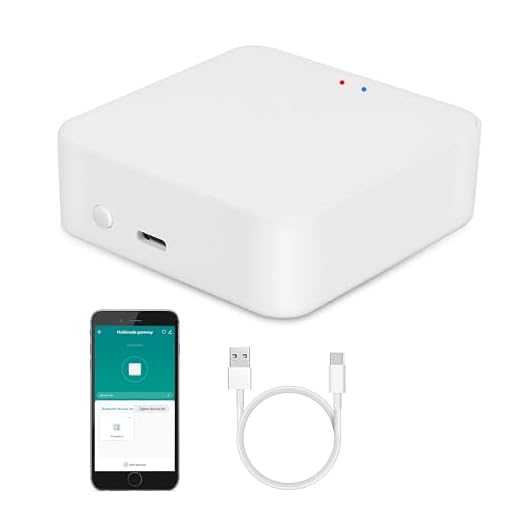
- Hub requirements – Thread mandates border routers for IP connectivity, Zigbee requires coordinators, and Z-Wave needs controllers—each with distinct capabilities affecting your network architecture.
- Device density support – Zigbee handles 65,000+ nodes per coordinator, Thread supports similar scales with mesh efficiency, while Z-Wave caps at 232 devices per network.
- Protocol version compatibility – Z-Wave 700 series chips maintain backward compatibility with 500 series devices, whereas Zigbee 3.0 bridges legacy profiles but doesn’t guarantee smooth operation with older implementations.
Hub Requirements and Network Setup for Each Protocol
Before deploying any mesh network, you’ll need infrastructure hardware that differs fundamentally across protocols.
Zigbee requires a coordinator hub—your control point that establishes the Personal Area Network (PAN) ID and manages routing tables.
You’ll configure the channel (11-26 in 2.4GHz) and enable router devices to extend network topology. Most implementations support 65,000+ nodes theoretically.
Z-Wave demands a primary controller that assigns NodeIDs and maintains the routing matrix.
You’re limited to 232 devices per network, though hub types like SmartThings or Home Assistant can bridge multiple networks. The controller handles network inclusion/exclusion and manages secure key exchange for S2 security.
Thread operates without traditional hubs—instead, you’ll designate Border Routers that connect the Thread network to IP infrastructure.
Each Border Router maintains the mesh’s network topology independently. You’ll need Matter-compatible controllers for application-layer device management, though the Thread network itself remains hub-independent and self-healing.
Choosing the Right Protocol for Your Smart Home Needs

Which protocol you select depends on three technical constraints: device ecosystem compatibility, network topology requirements, and security framework preferences.
Your protocol selection methodology should prioritize these factors:

1. Device Density and Range: Z-Wave excels in mesh networks up to 232 nodes with superior wall penetration.
Thread handles higher node counts but requires border routers for smart home integration.
2. Vendor Lock-in Tolerance: Zigbee offers maximum manufacturer diversity across 2,500+ devices.
Z-Wave guarantees interoperability through mandatory certification.
Thread’s Matter integration promises cross-platform functionality.
3. Latency Requirements: Thread’s IP-native architecture delivers millisecond-level responsiveness for time-critical automations.
Z-Wave and Zigbee introduce minor delays through hub translation layers.
4. Security Posture: Thread implements AES-128 encryption with secure commissioning by default.
Z-Wave S2 and Zigbee 3.0 require explicit security configuration during device pairing.
Match your network’s technical requirements against these protocol capabilities.
You’ll achieve peak performance through deliberate protocol selection rather than arbitrary vendor preference.
Frequently Asked Questions
Can Different Protocols Operate Simultaneously Without Interfering With Each Other?
Yes, you’ll find protocol compatibility allows simultaneous operation since Zigbee and Thread use 2.4GHz while Z-Wave operates on sub-GHz frequencies.
However, signal interference can occur when multiple 2.4GHz protocols compete for bandwidth with WiFi and Bluetooth. You’ll need to implement proper channel planning and network segmentation to maintain performance.
Z-Wave’s dedicated frequency band gives you an advantage here, letting you run it alongside 2.4GHz protocols without direct interference concerns or throughput degradation.
What Happens to My Devices if the Protocol Becomes Discontinued?
If your protocol’s discontinued, you’ll face potential device impacts including loss of certification updates, security patches, and manufacturer support.
Your existing network continues functioning since devices communicate locally, but you’re vulnerable without firmware updates.
Protocol lifespan considerations demand you evaluate manufacturer commitment and open-source alternatives.
You can migrate through bridge devices or gateway replacements, but you’ll need technical expertise.
Choose protocols with strong consortium backing and established ecosystems to enhance longevity and maintain control over your infrastructure.
Do These Protocols Work During Internet Outages or Power Failures?
When the grid goes dark, your smart home doesn’t have to follow suit. These protocols excel at local control—your Zigbee, Z-Wave, and Thread networks operate independently from internet connectivity, communicating directly through your hub.
However, device reliability hinges on backup power. Without it, battery-powered sensors survive while mains-powered devices fail.
You’ll maintain automation and manual control during outages if you’ve architected your system with uninterruptible power supplies protecting critical infrastructure nodes.
Can I Migrate Devices From One Protocol to Another Later?
You can’t directly migrate devices between protocols due to device compatibility restrictions—each protocol requires specific radio hardware.
You’ll need to purchase new devices for your target protocol. However, you can bridge protocols through compatible hubs that support multiple standards simultaneously, letting you gradually shift your network.
Protocol limitations mean there’s no universal translation layer; you’re fundamentally building parallel networks.
Plan your ecosystem carefully upfront to avoid costly replacements and maintain control over your smart home infrastructure.
Are There Monthly Fees or Subscriptions Required for These Protocols?
You won’t face subscription costs with Zigbee, Z-Wave, or Thread protocols themselves—they’re license-free for end users.
However, you’ll need to verify device compatibility with your chosen hub or controller. Some manufacturers bundle their hubs with optional cloud services that may carry fees, but local operation remains free.
You’re in full control: run everything locally without subscriptions, or selectively enable cloud features when they add value to your implementation.
Conclusion
You’ve now unsealed the absolute foundation of every single smart home decision you’ll ever make. These protocols aren’t just technical specs—they’re the invisible backbone that’ll dictate whether your automation dreams thrive or crash spectacularly. Choose Zigbee for massive device networks, Z-Wave for rock-solid reliability, or Thread for state-of-the-art Matter integration. Your protocol choice determines everything: latency thresholds, mesh topology efficiency, and interoperability success. There’s no going back once you’ve committed your ecosystem.
🔌 Editor’s Pick
Editor’s Pick: Versatile smart home hub for Zigbee, Z-Wave, and Thread protocol compatibility.
Make Your Home Smarter
Device reviews, automations, and the deals worth grabbing.
Related Articles You Might Like