

Smart irrigation technology replaces guesswork with precision: soil moisture sensors monitor root-zone hydration levels, while ET-based controllers process real-time weather data to eliminate wasteful cycles. You’ll cut outdoor water consumption by 50%—potentially 72% during droughts—through automated schedule adjustments that respond to atmospheric conditions and subsurface moisture content. Strategic zone mapping allows targeted delivery based on plant species, sun exposure, and soil composition. The initial investment typically pays for itself within 3-5 years through reduced utility costs, while proper installation and seasonal calibration protocols guarantee peak system performance year-round.
Key Takeaways
- Smart irrigation systems use soil moisture and weather sensors to automatically adjust watering schedules, reducing outdoor water consumption by up to 50%.
- Automated controllers serve as the system’s intelligence, integrating real-time data from sensors to deliver precise water amounts when needed.
- Installation involves minimal trenching by connecting controllers and sensors to existing infrastructure, then defining irrigation zones through digital programming.
- Systems achieve 72% water savings in drought conditions by eliminating redundant watering cycles based on root-zone moisture levels and precipitation detection.
- Initial investment pays back within 3-5 years through annual savings of $300-$600, while improving plant health and reducing maintenance costs.
The Water-Wasting Reality
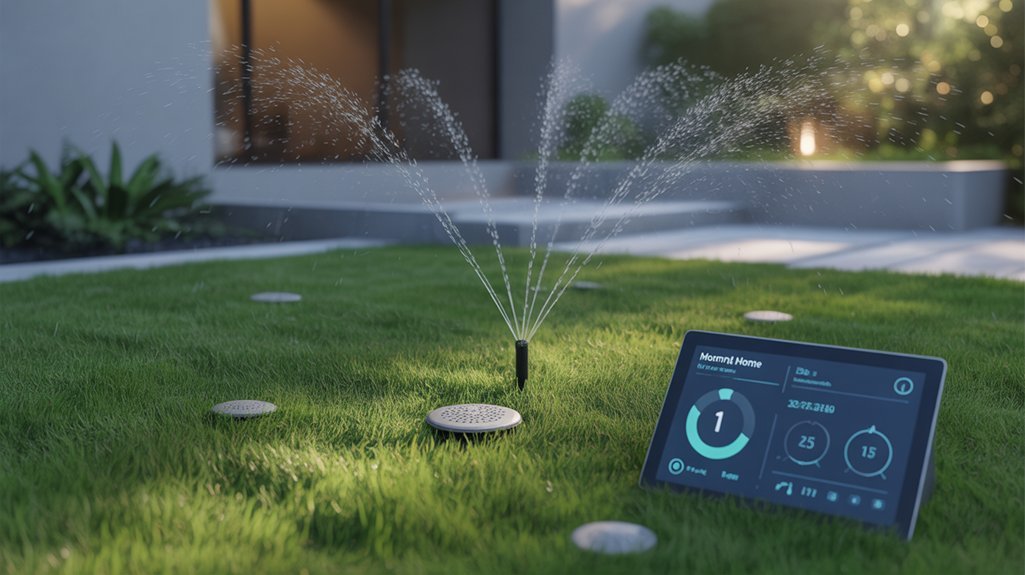
While homeowners take pride in maintaining lush landscapes, traditional irrigation systems undermine these efforts through inefficient water delivery mechanisms. Your conventional sprinklers generate overspray and mist-like droplets that compromise distribution patterns, creating uneven coverage while hemorrhaging thousands of gallons annually.
This operational failure stems from poor timing protocols and systematic overwatering—altering your investment into measurable resource loss and escalated utility expenditures.
The water conservation imperative demands immediate technological intervention. Smart irrigation systems deliver efficiency benefits through real-time weather data integration and adaptive scheduling algorithms, cutting outdoor consumption by 50%.

During drought conditions, soil moisture sensor controllers demonstrate 72% savings compared to manual homeowner schedules. You’ll enhance these gains by deploying add-on sensors—rain and wind detection units that interrupt unnecessary irrigation cycles.
This layered approach changes passive watering into responsive resource management, positioning your property at the intersection of environmental stewardship and operational excellence. Comprehensive home automation integration allows these smart irrigation systems to communicate with other devices in your ecosystem, creating a unified approach to both indoor and outdoor resource management.
Real Costs of Overwatering
Beyond the obvious waste streaming across your driveway, overwatering triggers a cascade of financial penalties that accumulate across multiple cost centers in your property management portfolio.
Overwatering effects compound exponentially:
- Direct utility impact: Your water bills escalate $300-$600 annually, draining resources that could fuel strategic property improvements or technology investments.
- Plant mortality and replacement: Excessive moisture creates anaerobic soil conditions, triggering root rot and pathogenic diseases. You’ll absorb increased maintenance cycles and premature landscape replacement costs that obliterate initial installation ROI.
- Structural degradation: Runoff accelerates soil erosion, compromising landscape integrity and requiring costly restoration interventions.
The cost implications extend beyond immediate expenses. Traditional fixed-schedule irrigation systems hemorrhage thousands of gallons yearly through mistimed cycles and weather-blind operation.
Smart irrigation technology offers decisive intervention—reducing consumption up to 50% while eliminating waste-driven expenditures. These modular solutions integrate seamlessly with existing property infrastructure, allowing you to scale functionality based on budget constraints and operational priorities. This alteration positions your property portfolio for sustainable operational efficiency and environmental stewardship.
Core Hardware & Components
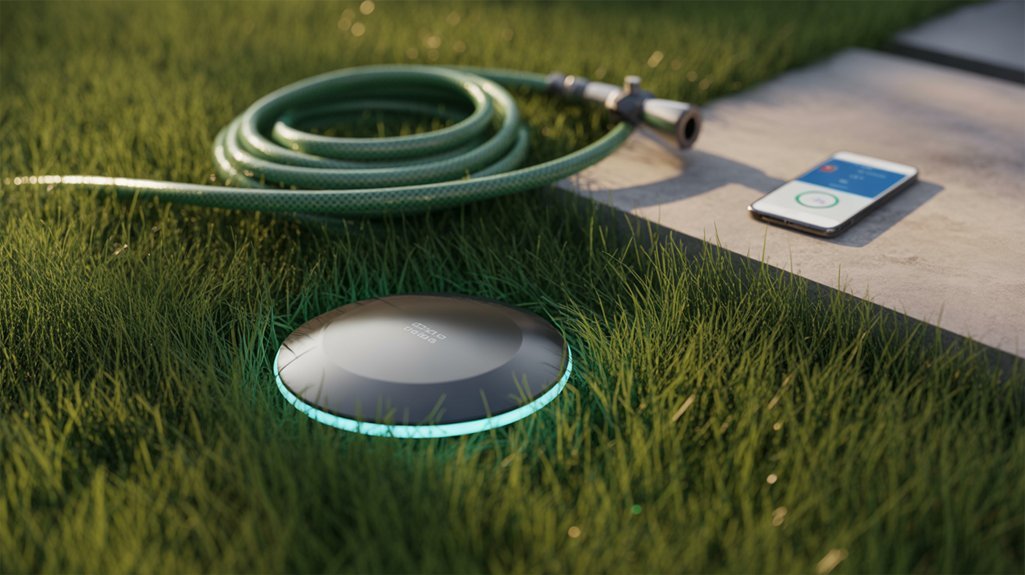
Smart irrigation architecture converts water waste into precision hydration through three foundational hardware elements: the automated controller (system intelligence), soil moisture sensors (subsurface monitoring), and weather sensors (atmospheric data integration). You’ll command water delivery with surgical precision through this layered approach, where sensor accuracy drives resource optimization and hardware integration eliminates guesswork.
| Component | Impact Metric |
|---|---|
| Soil Moisture Sensors | Up to 72% irrigation reduction |
| Automated Controllers | 50% water usage decrease |
| Rain/Wind Sensors | Eliminates waste during adverse conditions |
Modern systems like Rachio and Rain Bird utilize real-time atmospheric data through algorithmic processing, automatically adjusting delivery volumes and timing windows. Your soil sensors measure volumetric water content at root depth, transmitting subsurface conditions that override scheduled cycles when moisture thresholds are met. This architecture requires fewer spray heads than conventional systems, reducing installation complexity while maximizing coverage efficiency. You’re engineering ecological stewardship through strategic hardware deployment.
Installation: Zone Mapping to Activation
Installing your smart yard system converts digital precision into physical infrastructure through five critical stages.
You’ll begin by measuring your property and defining irrigation zones, then proceed to mount controllers and sensors before connecting everything to your water source.
The process concludes with systematic testing and calibration to guarantee each zone delivers water with ideal efficiency and ecological responsibility.
Measure and Map Property
Precision forms the foundation of any effective smart irrigation system, beginning with a detailed assessment of your property’s unique topography, plant zones, and water requirements.
Zone measurement demands meticulous documentation of each distinct area—from sun-exposed lawns to shade-dwelling plantings—enabling you to establish customized watering protocols that optimize resource efficiency.
Property mapping converts raw spatial data into actionable intelligence, identifying coverage gaps and overlap zones where traditional systems waste water. You’ll document slope gradients, soil composition variations, and existing vegetation density to create a thorough blueprint.
This digital framework replaces outdated fixed-spray configurations, allowing inch-level accuracy in water delivery. Advanced algorithms then capitalize on your mapped zones, adapting schedules through real-time weather integration and soil moisture analysis, ensuring every sector receives precisely calibrated irrigation.
Define Irrigation Zones
With your property blueprint established, you’ll translate that spatial intelligence into functional irrigation zones that respect ecological boundaries and water delivery constraints.
Zone differentiation categorizes landscape sectors by plant water requirements, soil composition, and solar exposure—creating hydraulic domains that command ideal resource allocation. This precision segmentation enables irrigation efficiency gains reaching 50% over conventional approaches, delivering measurable returns on your infrastructure investment.
Smart controllers execute zone activation through real-time meteorological integration and soil moisture analytics, adaptable calibrating delivery schedules.
Your installation footprint contracts considerably—fewer emitter points, reduced trenching, accelerated deployment timelines. Each zone operates as an independent hydration circuit, engineered to supply exactly what’s needed, when it’s needed.
You’re not watering a yard; you’re orchestrating a distributed water management system with surgical precision and ecological intelligence.
Install Controllers and Sensors
Your controller functions as the neural center of zone orchestration, translating meteorological intelligence into calibrated hydraulic commands across discrete irrigation circuits.
Smart controllers demand 80% less trenching than antiquated infrastructure, streamlining your installation pathway. You’ll execute precision zone mapping through digital programming—no manual cartography required.
Deploy soil sensors at strategic depths within each irrigation zone, positioning them where root biomass concentrates. These nodes deliver real-time moisture analytics, triggering water delivery exclusively when substrate conditions warrant intervention.
Your mobile command interface enables remote system manipulation, granting you operational sovereignty over every hydraulic parameter.
The activation sequence is direct: mount the controller hub, embed soil sensors across designated zones, sync meteorological data feeds, and initialize automated protocols that enhance water conservation while sustaining peak turf vigor.
Connect to Water Source
Establishing hydraulic connectivity begins at your property’s primary water source—the mainline supply that feeds your entire irrigation architecture.
Smart system connectivity demands minimal complexity: you’ll integrate just a few strategically positioned heads directly into your existing infrastructure. This efficient water source integration eliminates up to 80% of traditional trenching requirements, preserving your established landscape while delivering command-level control.
Digital programming replaces antiquated physical zone mapping, enabling you to configure coverage parameters without invasive lawn disruption.
Once connected, you’ll activate precision watering through an intuitive app interface that synchronizes with real-time meteorological data. The result? Inch-level accuracy that drastically reduces resource waste while optimizing turf health.
Your irrigation network becomes an intelligent ecosystem—responsive, efficient, and entirely under your strategic control.
Test and Calibrate System
Three critical phases convert your smart irrigation installation from connected hardware into a calibrated precision instrument.
First, execute zone-specific testing protocols—verify each sector’s coverage patterns and sensor accuracy against actual soil moisture readings. You’ll identify discrepancies that compromise system performance before they escalate into water waste or landscape damage.
Next, deploy calibration techniques that align watering duration with your terrain’s absorption rates and microclimatic conditions. Program the controller using local weather integration and real-time soil data to establish baseline schedules. This precision engineering delivers up to 50% water reduction while maintaining ideal turf health.
Finally, utilize mobile monitoring tools for continuous refinement. Remote diagnostics enable immediate adjustments, altering your irrigation network into a responsive ecosystem that adapts to environmental fluctuations with algorithmic precision.
Seasonal Schedule Optimization Strategies
When spring changes to summer or autumn shifts to winter, your smart irrigation system requires recalibrated watering schedules that align with dramatic shifts in evapotranspiration rates, precipitation patterns, and plant dormancy cycles.
Climate adaptation through ET-based controllers delivers measurable results—43% water reduction while maintaining turf quality. Moisture detection sensors override programmed cycles during adequate rainfall, achieving 72% savings in drought conditions.
ET-based controllers and moisture sensors transform irrigation efficiency, delivering up to 72% water savings while preserving optimal landscape health.
Maximize your system’s efficiency through strategic implementation:
- Deploy ET controllers that process real-time climate data to calculate precise watering requirements based on local atmospheric conditions and plant coefficients.
- Install soil moisture sensors at root-zone depth to eliminate redundant irrigation cycles and prevent water stress through data-driven scheduling.
- Configure mobile monitoring apps to override automated schedules when weather forecasts indicate precipitation, ensuring zero water waste from unnecessary cycles.
Regular seasonal calibration alters your irrigation infrastructure from reactive to predictive, securing both resource conservation and landscape dominance.
Sensor Placement Errors to Skip
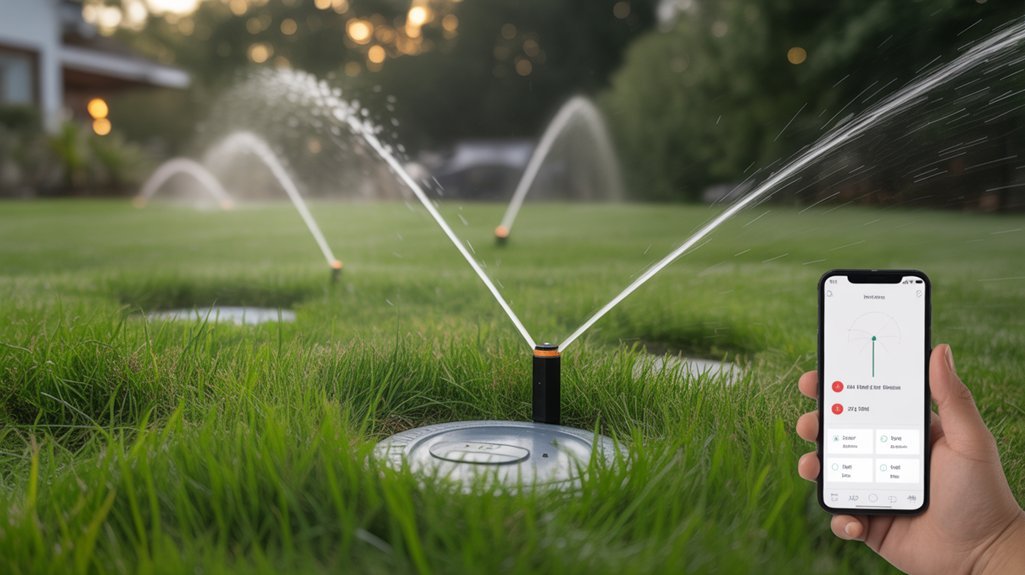
Your sophisticated ET controller and moisture sensors deliver ideal performance only when positioned according to hydrological principles—yet installation mistakes compromise 68% of residential sensor networks.
Optimal sensor depth of 6-12 inches captures root zone activity while avoiding moisture runoff distortions. Strategic positioning eliminates sensor obstructions like tree canopies and structural foundations that create microclimate anomalies.
| Critical Error | Performance Impact |
|---|---|
| Proximity to localized watering zones | Skewed readings trigger inefficient irrigation cycles |
| Inadequate sensor depth calibration | Misses root zone moisture variations |
| Installation in runoff corridors | False saturation signals cause underwatering |
| Neglecting functionality checks | Undetected failures waste resources |
| Ignoring debris cleaning protocols | Sensor degradation compromises data integrity |
Implement quarterly functionality checks and monthly debris cleaning regimens. Position sensors in representative hydrozones, maintaining minimum 3-foot clearance from irrigation heads. This precision-engineered approach enhances your water management authority while optimizing turf health outcomes.
ROI Timeline and Payback Period
How quickly does precision irrigation technology shift from capital expenditure to quantifiable asset? Your payback analysis reveals compelling metrics: systems typically recoup initial investments within 3-5 years through water cost reduction alone. Annual savings range from $300-$600, with soil moisture sensor controllers delivering up to 72% irrigation reduction compared to conventional methods.
| Technology Type | Initial Investment | ROI Timeline |
|---|---|---|
| Complete Smart System | $2,500-$3,000 | 3-5 years |
| Soil Moisture Controllers | $800-$1,200 | 2-3 years |
| Add-on Sensors (Rain/Wind) | $150-$300 | Under 1 year |
Investment returns accelerate through strategic component selection. Add-on sensors deliver sub-annual payback periods, making them your most aggressive ROI opportunity. At $500 average annual savings, you’re not merely purchasing irrigation equipment—you’re deploying capital-efficient technology that compounds ecological responsibility with financial performance. The mathematics favor decisive implementation.
Winterization and System Diagnostics
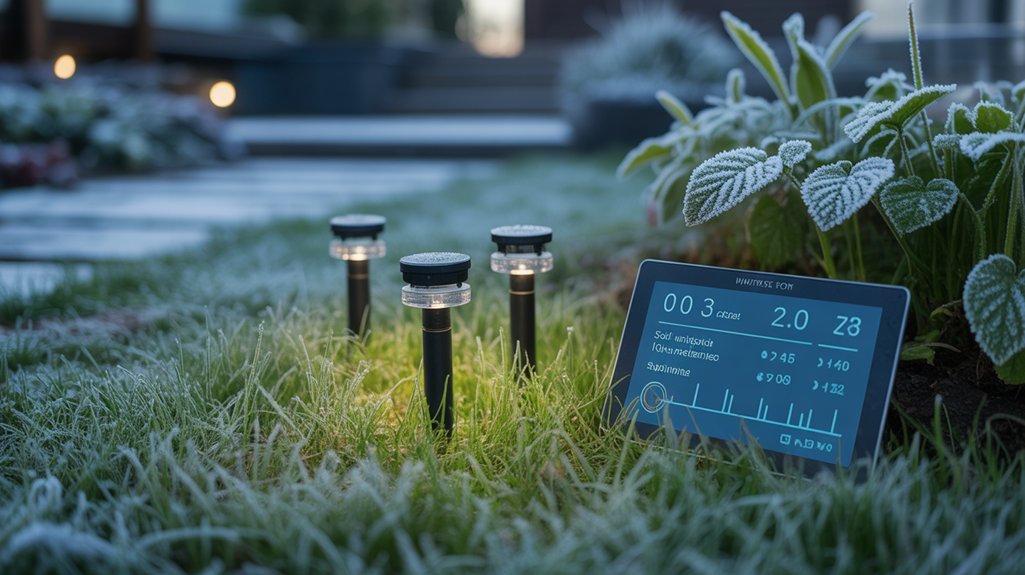
As temperatures decline below freezing thresholds, your irrigation infrastructure faces catastrophic pressure differentials—water expansion during phase change exerts forces exceeding 40,000 PSI, sufficient to rupture polyethylene lines, crack brass manifolds, and compromise electronic valve diaphragms.
Winter preparation demands systematic water extraction through compressed air purging, executed in late fall to eliminate destructive freeze-thaw cycles.
Your smart system’s diagnostic architecture provides tactical advantages through continuous monitoring:
- Predictive system alerts detect anomalies in pressure signatures, flow rates, and sensor conductivity before failure cascades occur
- Remote app-based diagnostics enable real-time troubleshooting from any location, eliminating reactive maintenance cycles
- Automated leak detection quantifies water loss patterns, protecting both infrastructure investment and resource allocation
These integrated capabilities convert winter preparation from defensive maintenance into strategic asset preservation.
Visual Setup Walkthrough Guide
Position your smart irrigation controller near power sources and Wi-Fi access points while maintaining weatherproof enclosure standards.
Install soil moisture sensors at root-zone depths—typically 6-12 inches—within each hydrozone’s representative planting bed. You’ll mount rain and freeze sensors in unobstructed locations for accurate precipitation detection.
Connect your smart technology to local weather stations through the manufacturer’s app, enabling predictive watering adjustments that minimize environmental impact.
Link your controller to weather stations via the app for automated, eco-friendly irrigation adjustments based on real-time forecasts.
Configure zone-specific parameters including soil type, slope percentage, and nozzle precipitation rates for precision calibration.
Verify sensor accuracy by cross-referencing readings with manual measurements during initial testing phases.
This systematic approach guarantees your automated system delivers maximum resource efficiency while reducing water waste by up to 50%, giving you complete command over landscape sustainability.
Your Smart Watering Action Plan
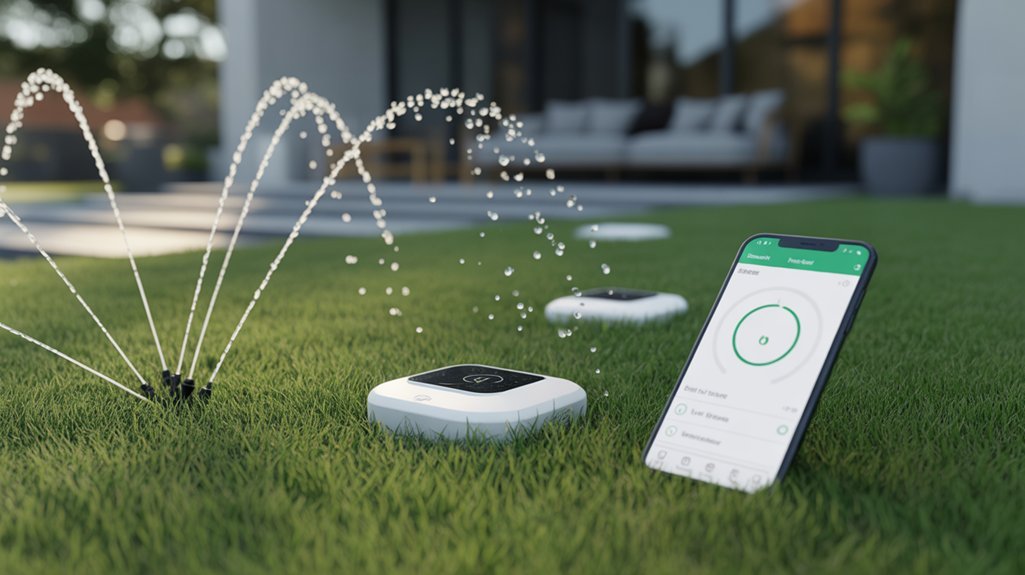
With your sensors calibrated and connectivity established, convert these installations into an energetic water management strategy. Command immediate irrigation benefits by programming controllers to utilize real-time weather data and soil moisture readings—achieving up to 72% water reduction during drought conditions.
Deploy Rain Bird or Irrigreen systems to automate schedules that respond flexibly to local climate variables, eliminating the guesswork that drains resources.
Integrate add-on rain and wind sensors to override scheduled watering when conditions make irrigation counterproductive. This smart technology layer prevents waste while maintaining landscape vigor.
Monitor performance metrics through dedicated apps, adjusting parameters as seasonal demands shift. Your system should operate as a closed-loop ecosystem: sensors detect, controllers calculate, and actuators execute precise water delivery.
This approach alters traditional irrigation into a high-efficiency protocol that cuts utility costs by 50% while optimizing plant health. You’re not just conserving water—you’re engineering sustainable landscape dominance.
Frequently Asked Questions
Can Smart Watering Systems Work With Existing Sprinkler Setups?
Yes, you’ll find smart irrigation controllers effortlessly replace your existing timer while maintaining full sprinkler integration with your current valve system.
You’re leveraging weather data, soil moisture sensors, and zone-specific programming to enhance water delivery through your established infrastructure.
This retrofit approach means you’re commanding precision without costly reinstallation.
You’ll achieve 30-50% water reduction while enhancing landscape health—it’s strategic resource management that enables you to maintain ecological responsibility without compromising performance or control.
Do These Systems Function During Power Outages or Internet Disruptions?
You’ll need power backup solutions—most smart controllers include battery reserves maintaining programming during outages, though they won’t operate valves without electricity.
Internet reliability affects cloud-based scheduling, but premium systems store watering programs locally, ensuring your landscape’s survival during connectivity lapses.
You’re fundamentally trading complete autonomy for intelligent resource management.
Consider hybrid approaches: retain manual override capabilities while leveraging smart features.
This architectural redundancy protects your investment in sustainable irrigation infrastructure, giving you control when technology falters.
Are Smart Yard Systems Compatible With Well Water Sources?
Yes, you’ll find excellent well water compatibility across most smart yard systems.
You can enhance irrigation efficiency by configuring pressure settings and flow rates specific to your well’s output capacity. Modern controllers let you monitor water levels and adjust delivery schedules to prevent well depletion.
Install a pressure tank and backflow preventer to protect both your well infrastructure and irrigation system.
You’re gaining complete control over resource management while maximizing landscape performance.
What Ongoing Maintenance Costs Should Homeowners Expect Annually?
You’ll invest modest resources—annual costs typically range $150-400 for your smart yard system.
Maintenance considerations include sensor calibration, filter replacements, and software updates. You’re commanding sophisticated infrastructure requiring valve inspections, nozzle cleaning, and winterization protocols.
Battery replacements for wireless sensors add $30-60 yearly. If you’re operating well-based systems, you’ll monitor pump efficiency and pressure regulation.
Premium monitoring subscriptions cost $50-150 annually, delivering complete environmental data control and predictive analytics for ideal resource deployment.
Can Renters Install Temporary Smart Watering Systems Without Permanent Modifications?
You’ll gain full control with portable irrigation systems designed for non-invasive deployment.
These battery-powered hubs connect via standard hose threads, requiring zero structural modifications that’d violate rental restrictions.
You’re implementing sophisticated moisture monitoring through wireless sensors that stake temporarily into soil, while timer-controlled valves enhance water delivery with precision algorithms.
This approach increases resource efficiency and plant health without compromising your security deposit—you’ll simply disconnect and relocate when your lease ends.
Conclusion
You’ll recover your investment within 18-24 months while cutting outdoor water use by up to 50%—a figure that translates to roughly 7,800 gallons saved annually per household. Your smart yard system doesn’t just automate irrigation; it creates a responsive ecosystem where soil moisture data, weather patterns, and plant-specific needs converge into precision hydration. You’re not maintaining a lawn anymore—you’re engineering a sustainable landscape that conserves resources while optimizing growth conditions through intentional, data-driven design.
Related Articles You Might Like